
AI Fall Detection in Senior Living: What I Tell Chicagoland Families After “The Call”
By Ryan — Eldercare Advisor at Senior Placement Solutions
There’s a phone call I’ve watched families take more times than I can count. It usually comes in the middle of the night, or first thing in the morning before they’ve had coffee. Mom fell. She was on the floor for hours. The neighbor found her. The hospital is admitting her.
That call is almost always the moment a family stops asking if their parent needs more support and starts asking where.
In my years as a senior care advisor here in Chicagoland, falls are the single most common reason families end up sitting across the kitchen table from me. Not memory loss. Not a sudden diagnosis. A fall. And by the time we’re talking, the family is usually exhausted, scared, and grieving the version of their parent that existed before the fall.
I want to talk about something that’s actually starting to change this story — AI fall detection — and why it’s one of the first things I now look for when matching a family with the right assisted living community.
Why Falls Are the #1 Trigger for “It’s Time”
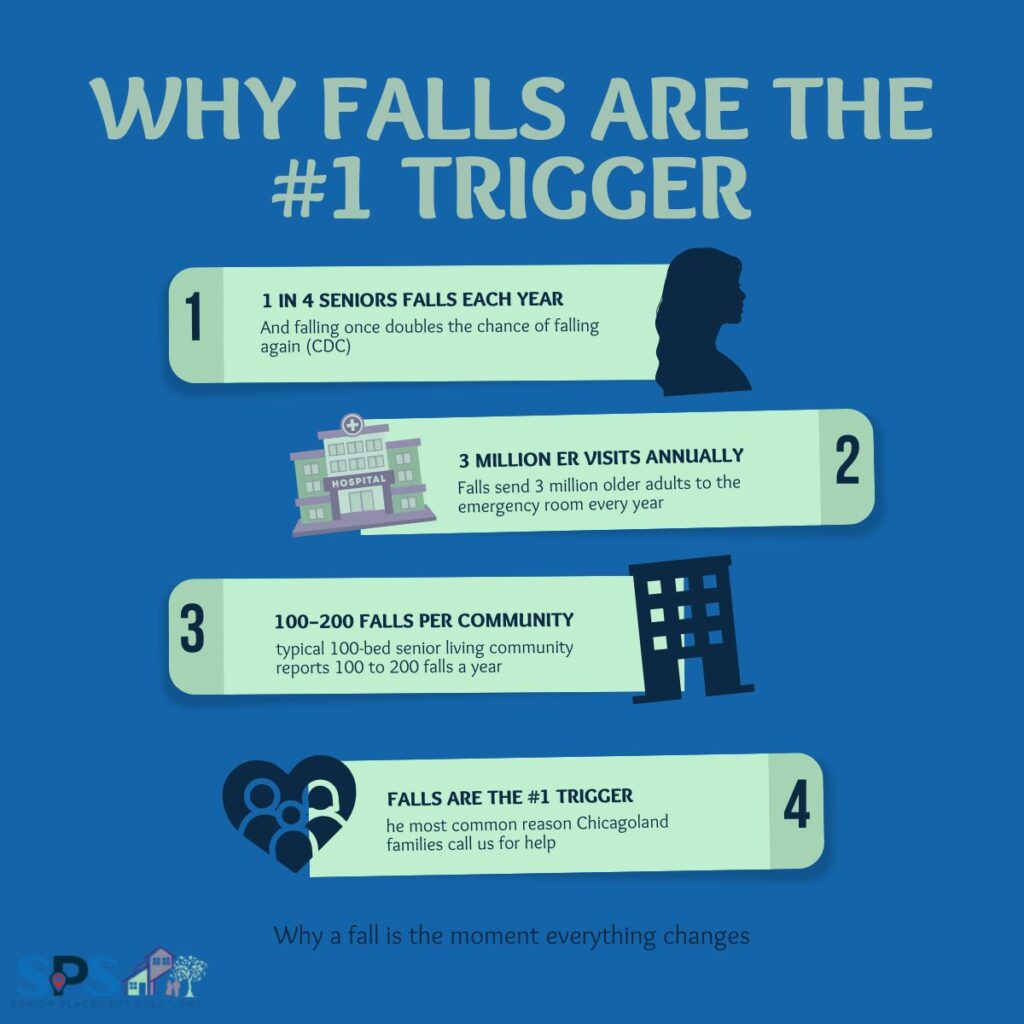
The numbers back up what I see every week. According to the CDC, more than one in four adults over 65 falls every year, and once someone falls, their chance of falling again doubles. About 3 million older adults end up in emergency departments each year because of falls, and roughly 1 million are hospitalized.
In long-term care settings — assisted living, memory care, skilled nursing — the picture is even more sobering. Industry research puts the fall rate at about 1.7 falls per resident per year, and in some skilled nursing settings it’s higher. A typical 100-bed community will see 100 to 200 falls a year.
But the statistic that hits hardest for families isn’t on a CDC page. It’s the one I hear in their voices:
“She was on the floor for nine hours before anyone found her.”
That’s the part that breaks people. Not just the fall itself — the time on the ground. The dehydration. The bruising. The pressure injuries. The pneumonia that follows. The hip fracture that turned a strong, sharp, independent parent into someone who never quite came back.
The Stress on Families Nobody Talks About
Before I get into the technology, I want to say something about what the family experiences in the months before a fall sends someone to assisted living.
Adult children describe it the same way over and over. Every time the phone rings, their stomach drops. They keep their ringer on through dinner, through meetings, through their kids’ bedtimes. They drive across town two and three times a week to “just check.” They wake up at 2 AM and lie there wondering if Dad got up to use the bathroom okay.
That kind of low-grade, constant fear is its own injury. It wears down marriages, careers, sleep, and the relationship between adult children and their parents. By the time we talk, the family is often more depleted than the senior is.
Part of why I push families to take AI fall detection seriously is that it’s one of the only things I’ve seen meaningfully turn the temperature down on that fear.
The Bathroom-at-Night Problem
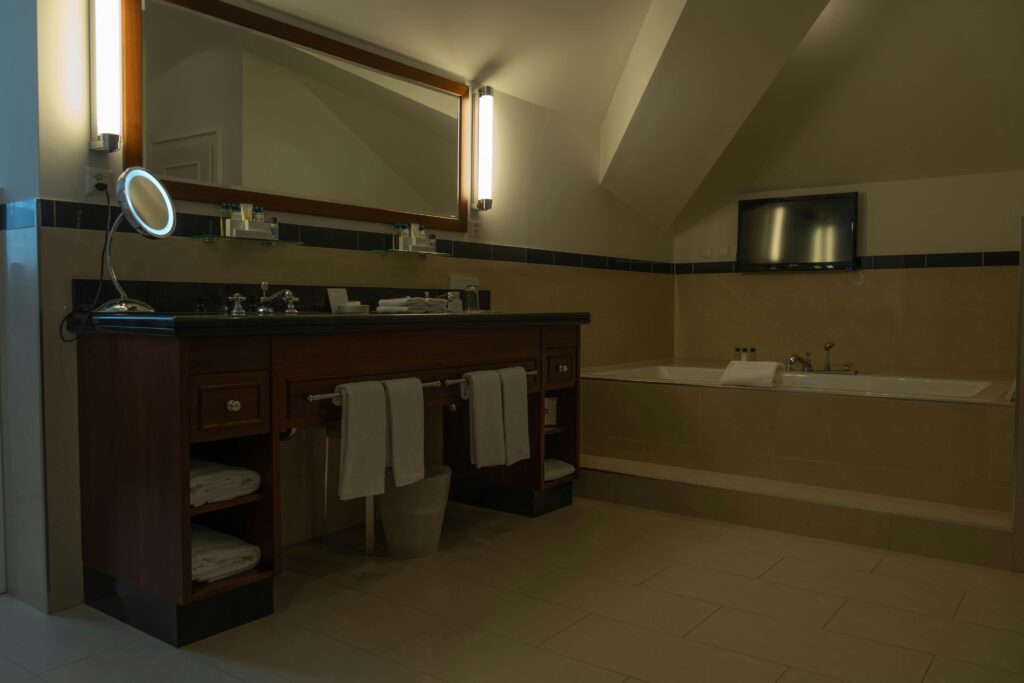
Here’s the thing most people don’t realize until I explain it: a huge percentage of senior falls happen at night, on the way to the bathroom.
Sleep medications, low blood pressure when you stand up, a dark room, slippery socks, a rug, an unfamiliar layout — they all stack on top of each other. The senior wakes up needing the restroom, doesn’t fully wake up, doesn’t reach for the walker, and goes down.
Now picture that scenario in a traditional assisted living community. Overnight, most communities are doing rounding checks every two hours. That’s not negligence — it’s industry standard, it’s reasonable for staffing, and it’s how most communities have always operated.
But the math is what it is. A fall at 12:15 AM might not be discovered until 2 AM. That’s an hour and forty-five minutes on the floor.
Cold tile. No call button reachable. Maybe a head injury. Maybe a broken hip that’s now going to require surgery in someone who was already frail.
This is the gap that AI fall detection is designed to close.
Why Cameras Alone Are Not the Answer
When families first hear about technology in resident rooms, the natural reaction is, “Oh, so they’re putting cameras in the rooms?” And the answer is — kind of, but not the way you think.
Traditional video cameras have real problems in senior living:
- Someone has to be watching. A camera that nobody is monitoring at 2 AM is just a recording device. It documents the fall but doesn’t shorten the response time.
- They create privacy issues. Most residents — and most families — are not comfortable with continuous, recorded video of bedrooms and bathrooms.
- They flood staff with footage. Even if a community had someone watching, you can’t have one staff member watching dozens of feeds and reliably catch a fall the moment it happens.
That’s why traditional cameras have never really taken off in assisted living. The privacy trade-off was too high for the safety benefit you actually got.
AI changes that equation entirely.
What AI Fall Detection Actually Does Differently
The way the newer systems work — platforms like SafelyYou, KamiCare, AUGi, and Inspiren are the names you’ll hear most often — is that the device in the room is only paying attention to one question: “Is there a person on the floor in a position that looks like a fall?”
It’s not a person watching video. It’s a computer-vision algorithm that, in most setups, only captures or transmits footage when an incident is detected. Many of the systems blur the resident’s image for any human review and only allow authorized care staff to see clear footage after a fall, for incident reporting and prevention planning.
The practical difference is enormous:
- Response time goes from up to two hours to seconds or minutes. The moment the system detects a fall, the care team gets an alert on their phones. They don’t have to wait for the next rounding pass.
- Privacy is much better preserved than with traditional cameras. No one is watching live. The system isn’t archiving hours of bedroom footage. It activates around an incident.
- The community learns from each fall. Several of these platforms let the clinical team review what actually happened — did Dad try to stand without his walker? Did he get tangled in the sheets? — so the care plan can be adjusted to prevent the next one.
- Some systems even predict. A few of the more advanced platforms track changes in movement patterns — restlessness, gait changes, increased nighttime activity — and flag residents whose fall risk is rising before they actually fall.
When I tell families that, I usually see their shoulders drop two inches. It’s the first time in months they’ve heard about something that addresses the actual problem keeping them up at night.
What This Looks Like in Chicagoland Communities
AI fall detection is still rolling out unevenly across the Chicagoland market. Some communities have it building-wide. Some have it only in memory care, where fall risk is highest. Some are piloting it. Some are evaluating it. Some haven’t gotten there yet.
I keep a running list of which communities in my coverage area have it, which platform they use, and which neighborhoods of the building it covers. That list changes regularly as more communities sign on, so I’m not going to publish a static version of it here — by the time you read this, it would already be out of date. But it’s exactly the kind of detail I bring to a family the first time we sit down.
If you want to ask a community directly, here are the questions I’d want answered:
- Do you have AI-powered fall detection in resident rooms? Which platform?
- Is it in every apartment, or only in certain levels of care (memory care, for example)?
- How quickly does staff respond when the system alerts?
- How is resident privacy handled? When is footage captured, and who can see it?
- Do families get notified after a fall? How quickly?
- Do you use the data from the system to update care plans?
If the answers are vague, that tells you something. If the community can walk you through it in detail, that tells you something too.
A Note for Families Whose Loved One Is Already Falling Frequently
If your parent or spouse is falling more than once a month — or has already had the fall that put them in the hospital — please don’t try to navigate this alone.
The senior living landscape in Chicagoland is genuinely complicated. Communities vary wildly in fall protocols, staffing ratios, technology investments, and the kind of resident they’re built to care for. A community that’s perfect for an active 78-year-old with mild balance issues may be completely wrong for an 86-year-old with cognitive decline and three falls in the last six months.
This is where an advisor earns their keep. My job is to know which communities have the technology, which have the staffing, which have the memory care credentials, and which one is going to actually fit your family’s situation, budget, and geography. I tour these communities. I know the directors. I know which ones I’d put my own mother in.
And our service is free to families — communities pay a referral fee when a placement works out, which means I’m only doing well if you’re placed somewhere that’s the right fit.
If You’re in the Middle of This Right Now
If you’re reading this because you just got “the call,” or because the calls are starting to come more often, here’s what I’d say:
You are not overreacting. You are not being dramatic. The fact that you’re researching at 11 PM tells me you already know something needs to change.
Reach out. We’ll talk through what’s happening, where your loved one is at clinically, what your family can sustain, and which communities are realistic options. If AI fall detection is the right priority for your situation, I’ll tell you which communities have it. If something else matters more, we’ll focus there.
You don’t have to figure this out alone. That’s the whole reason this job exists.
Senior Placement Solutions is a Chicagoland-based senior living advisory service helping families find the right assisted living, memory care, independent living, and skilled nursing community — at no cost to the family. Reach out anytime through our contact page and we’ll set up a time to talk.